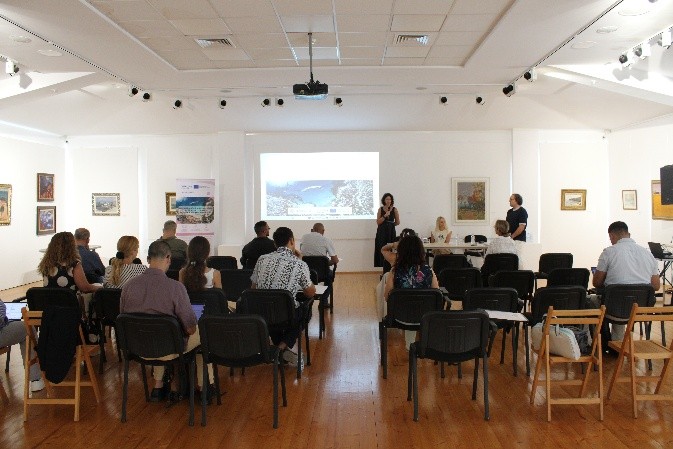

On 3rd September 2026, the RECIRCLE MED project successfully organized its Local Capacity Building Workshop in Pomorie, Bulgaria bringing together local stakeholders, tourism experts, and representatives of the academic community and local institutions to strengthen capacities for the implementation of blue and circular tourism.
Organised by the National Association of the Municipalities in the Republic of Bulgaria (NAMBR) in collaboration with the Municipality of Pomorie and hosted at the City Art Gallery “Dechko Stoev”, the workshop aimed to enhance local knowledge and skills while supporting stakeholders in adapting the RECIRCLE MED Blueprint to local needs and contributing to the development of local Action Plans for Blue and Circular Tourism.

Designed around the specific needs and challenges of the local tourism ecosystem, the event created a collaborative environment for learning, exchanging experiences, and co-designing sustainable tourism solutions. Throughout the day, participants explored how blue and circular economy principles can be integrated into tourism development and discussed the opportunities and challenges associated with applying these approaches in Pomorie.
The workshop was opened by the Mayor of Pomorie, Mr Ivan Aleksiev, who highlighted the importance of tourism to the local economy and the wider development of Pomorie. At the same time, he stressed that tourism development must go hand in hand with the protection of local cultural and natural heritage and the responsible management of natural resources.

The strong participation of municipal representatives and experts throughout the workshop further demonstrated Pomorie’s commitment to combining environmental protection with sustainable economic development.
Following the opening remarks, the workshop continued with three thematic and highly interactive sessions, gradually moving from knowledge exchange to practical exercises and the co-design of local actions.
The first session commenced with Professor Dora Papatheochari from the University of Thessaly, who introduced and described the principles of circular and blue economy integration in tourism. She highlighted the significant economic, social, and environmental impacts of tourism, particularly in coastal destinations that receive large numbers of visitors each year and highlighted the benefits of blue and circular tourism approaches in tourism for destinations.

Following the presentation, Ms Tonia Koutsopoulou from the University of Thessaly introduced and coordinated a series of participatory exercises with local stakeholders, in which local stakeholders were asked to identify the main barriers Pomorie has towards achieving more sustainable tourist models and how to overcome it and to describe their ideas on how the city could look like following the implementation of the blue and circular action plan.

The second session focused on the implementation of the Blueprint and was presented by Ms Giulia Bonello from the Energy and Water Agency of Malta (EWA) and Ms Marusya Tsvetkova, Senior Expert for Institutional Projects at NAMRB.

The session was complemented by contributions from representatives of Cefalù and Bar, who shared tourism-related challenges faced by their territories and presented practical examples of measures and approaches being implemented in those territories to address them, following by discussion among stakeholders from the different participating territories, providing an opportunity to compare experiences, understand how different solutions work in practice, and explore how successful approaches could be adapted to other local contexts.
The third and final session represented the most participatory part of the workshop and focused on the co-design of the Blue Action Plan. During this session, local stakeholders, experts and partners worked collaboratively to identify gaps, challenges, and opportunities, aiming to contribute to the development of locally adapted actions that could reinforce sustainable tourism transformation in the area.
The Local Capacity Building Workshop held in Pomorie demonstrated how knowledge exchange, local expertise and participatory planning can come together to support the transition towards more sustainable tourism destinations.
Through activities such as this workshop, RECIRCLE MED continues to support local communities and tourism ecosystems in developing more resilient, inclusive, and sustainable tourism models based on cooperation, knowledge exchange and innovation.